
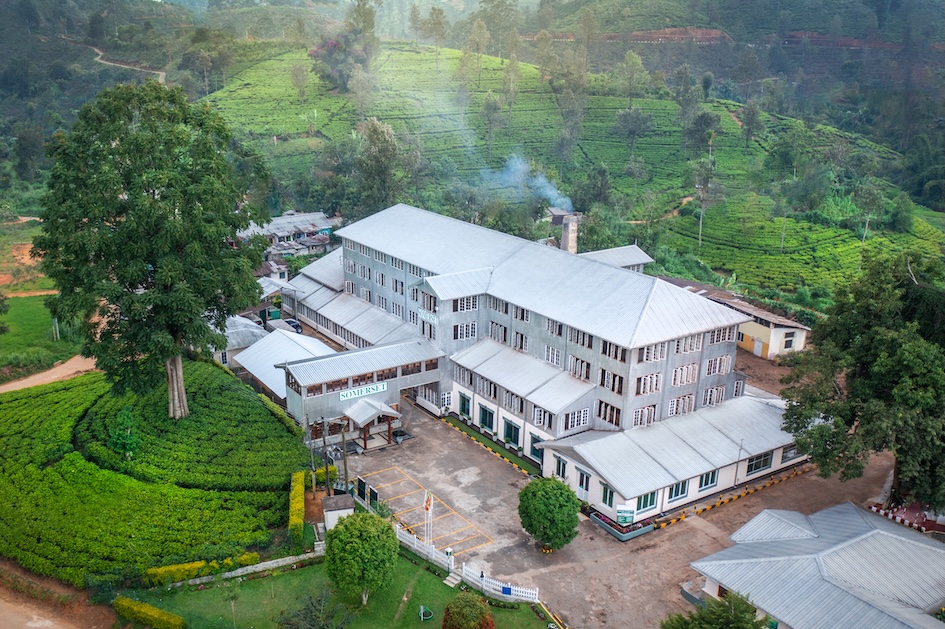
Perched beside the Nanu Oya railway station, built in 1885 to carry Dimbula’s tea down to Colombo, Somerset remains one of the most accessible, and most storied, high-grown estates in the region. Its heritage rests on three threads: machinery and families that have outlived generations of planters, a steady embrace of new technology, and a standard of quality that has never wavered. Somerset is not a relic, but a working estate, still carrying forward a story that began nearly a century and a half ago.
A tea garden that keeps reinventing its own ground
Roughly half of Somerset’s bushes are old seedling China Jat varieties, descendants of the very first tea plants brought to Ceylon in the 19th century, at their best during the Western quality season from January to March, producing teas with a character that still echoes tea’s earliest days on the island.
But heritage here is not preserved in amber. The rest of the bushes are newer varieties, planted closer together to mature faster, while biochar, a soil amendment made from slow-burnt organic matter, helps fields hold water better and rely less on synthetic inputs. Not every acre can grow tea, and Somerset has stopped treating that as a loss. Native trees now grow on steeper, poorer slopes in the pattern of a natural forest, while fast-growing timber fills ground tea could never use, turning idle land into income.
That same instinct runs through a 13-kilometre biodiversity corridor along the Nanu Oya and Agra Oya river basins, developed with the Wildlife and Nature Protection Society of Sri Lanka, which aims to restore 80 hectares of forest, with over 50,000 native trees planned to be planted in the future. Taken together, it’s an estate that has learned to grow more than tea, turning every corner of its land into part of the same living landscape.
Optimising work through technology
The clearest evidence of change is what one witnesses in real time. A digital weighing system has done away with manual scales at field level, giving pluckers accurate records of what they have picked and management a live view of daily harvest volumes, feeding directly into how transparently earnings are calculated.
A cloud-based monitoring system tracks plucking rounds, fertiliser schedules and pest pressure as they happen, and a similar system inside the factory follows withering, rolling, fermentation, drying and grading in real time, letting supervisors adjust through the demanding weeks of the Western quality season, part of a factory automation push TTE PLC has rolled out across all fifteen of its estates. Somerset has also turned to drones for fertiliser application on its steepest terrain, replacing manual and tractor spreading with precise aerial delivery that cuts waste, reduces labour on difficult slopes, and lowers the risk of soil compaction and runoff, an early, visible marker of precision agriculture in Sri Lankan tea.
A mark buyers travel for
The estate’s newest addition is the Somerset Tea Boutique at Nanu Oya, opened under the Somerset TeaTel brand. It gives travellers on the Colombo-Nuwara Eliya route a place to pause and taste estate-fresh black teas, classic milk tea and single-estate packs, turning a brief stop into a lasting memory of the valley. Visitors can enjoy a Tea tour at Somerset, which offers them a first-hand opportunity to experience on situ plucking, tea tasting and the production process. Therefore, Somerset is the ideal place to visit for Ceylon Tea history where traditions are still very much intact. During the Western quality season, it also becomes a natural meeting point for international buyers, Japanese buyers especially, who travel to Somerset each year to source seasonal teas fresh off the line.
The tea itself has never needed much persuading. In 2022, Somerset set a record price of Rs. 2,600 per kilogram for its best grade, broken in March 2025 when a single lot sold for Rs. 3,050 per kilogram, the highest ever paid for tea of its kind from the region. That year, Somerset was also named Runners-Up for Outstanding Tea Producer at the Tea Exporters Association Awards, capping a decade among the area’s top producers.
That reputation travels well beyond Colombo. Dilmah retails Somerset teas in the UK through its Watte Boutique and Teamaker’s Private Reserve ranges, and Twinings of London has sourced it for its single-origin Ceylon range. Additionally, Germany’s taste for certified, traceable tea suits Somerset well, and through its parent company’s network, Somerset teas also reach the Middle East, the US and China.
The drive towards sustainability
The estate has also put its landscape to work beyond the tea bush. Its own mini-hydropower plant, run through TTEL Somerset Hydro Power, draws on the Kotmale Oya and Nanu Oya watershed through a 1,100 kW installation that generated 3,622,254 kWh in FY2025/26 at 95 percent capacity, powering the estate and feeding the national grid as part of TTE PLC’s 87 percent renewable energy mix, a revenue stream independent of tea prices.
With the Coca-Cola Foundation, Janathakshan and Neptune Recyclers, the estate also runs an ECO Material Collection and Processing Centre, collecting and processing PET plastic waste from Somerset and its surrounding community. It runs entirely on the estate’s own hydroelectricity and has created jobs, particularly for women and young people.
145 years of heritage measured in generations
Before Somerset was tea, it was forest and, in patches, coffee, the crop that briefly promised fortune to Ceylon’s planters before disease wiped it out. Tea took root here in 1880, just thirteen years after James Taylor planted Ceylon’s first commercial tea at Loolecondera, part of a shift playing out across all of Dimbula.
Somerset’s first manager, C.M.B. Wilkins, took charge in 1880, followed by G.A. Talbot and then S.R. Smethurst, who ran the estate for thirty-two years, one of the longest tenures on record. Ownership changed hands several times since, from private to corporate control, then state management in 1972, before privatisation in 1992 brought Somerset into Talawakelle Tea Estates PLC, later acquired by Hayleys Plantation Services in 1998 and listed on the Colombo Stock Exchange in 2000. Through it all, Somerset kept producing tea.
That continuity lives on in the factory, where machinery still in daily use is around 140 years old, and in the colonial-era superintendent’s bungalow, once the centre of plantation life and still much the same today. But Somerset’s real strength lies in human capital. Some plucking families have worked here for five generations, a legacy built by women pluckers whose skill made Somerset’s name long before anyone wrote it down.
Today, 440 people carry that legacy forward, and it is this thread, as much as the machinery or the bushes, that Somerset’s newer efforts are quietly working to protect. Nearly a century and a half after the first bush went into the ground, Somerset remains what it has always been: a working estate, still finding its footing in a changing world, still carrying a story worth telling.